You've read that slow feeder bowls are good for dogs. But your dog has used a regular bowl for years and seems fine. Is a slow feeder really necessary — or is it just another pet product looking for a problem to solve?
The short answer: it depends entirely on how fast your dog eats. For slow, calm eaters, a regular bowl is perfectly adequate. For fast eaters — and the majority of dogs are — the difference between the two bowls is not marginal. It's the difference between a daily health risk and a daily health benefit.
Here's the full comparison, category by category.
Gets the job done.
Nothing more.
- Food gone in 30–90 seconds
- Large air volumes swallowed
- No digestive support
- No mental stimulation
- Zero enrichment value
- Easy to clean
- Lower upfront cost
A daily investment
in your dog's health.
- Meal extended to 5–15 minutes
- Minimal air swallowed
- Better chewing, better digestion
- Puzzle challenge at every meal
- Foraging instincts activated
- Dishwasher safe (good designs)
- One-time purchase, years of use
Head-to-Head: 6 Rounds
Eating Speed & Air Swallowing
This is the most fundamental difference between the two bowls, and the one with the most direct health consequences. A regular bowl presents zero resistance — food is accessible from any angle, in any quantity, at any speed the dog chooses. Most dogs choose maximum speed.
A slow feeder's maze, ridges, or multi-level puzzle design physically prevents dogs from accessing more than a small amount of food at once. They must navigate the obstacle, pick up one or two kibbles at a time, and reposition constantly. This mechanical constraint is not something the dog can override through motivation or determination — the design works regardless of how hungry or eager the dog is.
Digestion & Nutrient Absorption
Digestion begins in the mouth. Chewing breaks food into smaller particles and mixes it with saliva, which contains amylase — an enzyme that begins breaking down carbohydrates before food reaches the stomach. A dog eating from a regular bowl at full speed skips this process almost entirely: food enters the stomach in large, barely-chewed chunks.
The stomach and small intestine then have to work significantly harder to process what arrives. The result is reduced nutrient absorption, slower gastric emptying, and the classic cascade of discomfort: gas, bloating, and sometimes regurgitation. Over months and years, chronically poor digestion affects coat quality, energy, stool consistency, and overall health.
A slow feeder forces more chewing by design. More chewing means better enzymatic pre-processing, smaller food particles entering the stomach, improved nutrient extraction, and measurably better digestive outcomes over time. Owners who switch to slow feeders consistently report improvements in stool quality and coat condition within 2–4 weeks.
Bloat & GDV Risk Reduction
GDV — the life-threatening condition where the stomach fills with gas and twists — requires a trigger. Fast eating and its associated air swallowing is one of the most consistently identified triggers across veterinary research. A regular bowl does nothing to address this. A slow feeder directly attacks the mechanism.
For most dog owners, this round is the most consequential. A regular bowl costs less upfront but carries a silent, cumulative health cost for fast-eating dogs. A slow feeder's one-time cost of $24.99 is not an optional upgrade — for large breeds especially, it's a meaningful medical preventive.
Consider the math: a single GDV emergency costs $3,000–$8,000 with no guaranteed outcome. A quality slow feeder costs $24.99. The risk reduction it provides — by consistently reducing the primary modifiable trigger of GDV at every single meal — makes it one of the highest-value health purchases available for large breed owners.
No single preventive measure eliminates GDV risk. But reducing air swallowing through slower eating, combined with smaller meal portions and post-meal rest, represents the current best-evidence approach for risk reduction in at-risk breeds.
A slow feeder addresses the most modifiable factor — eating speed — consistently at every meal, automatically, without requiring you to remember or intervene.
Mental Stimulation & Enrichment
A regular bowl is a passive object. Food goes in, dog takes food out. There is no cognitive engagement, no problem-solving, no use of the dog's natural foraging instincts. The meal is over in under a minute and the dog returns to whatever state of boredom or restlessness they were in before.
A well-designed slow feeder — particularly a multi-level puzzle or spinning design — activates your dog's brain at every meal. They use their nose to locate food in channels, their tongue to extract it from grooves, and their problem-solving ability to find the most efficient approach. This engages the prefrontal cortex in ways that direct food access never does.
The dopamine released through problem-solving and reward is measurably calming. Dogs fed from slow feeders are consistently calmer in the hour after meals compared to dogs fed from regular bowls — a benefit that compounds across every mealtime, every day. For anxious dogs, high-energy breeds, or dogs that are left alone during the day, this effect is particularly significant.
Ease of Cleaning & Maintenance
This is the one category where a regular bowl genuinely has a structural advantage: a flat surface is trivially easy to rinse, scrub, or run through the dishwasher. No grooves, no channels, no trapped food.
A slow feeder's cleaning experience depends entirely on design. Poorly designed slow feeders with deep, narrow channels are hygiene nightmares — wet food residue collects in unreachable grooves and bacteria grows rapidly. This is a genuine problem with some models on the market, and it's a reason to choose carefully.
However, well-designed slow feeders with rounded, accessible channels and dishwasher-safe construction are no harder to maintain than a regular bowl. The key is to look for: channels wide enough for a dishwasher jet to reach, food-grade materials that don't hold odours, and a top-rack dishwasher-safe rating. A good slow feeder is as clean as a regular bowl after one dishwasher cycle.
Total Cost of Ownership
A regular bowl appears cheaper upfront. A basic stainless steel bowl might cost $8–15. A quality slow feeder costs $24.99. That's the entire price difference — roughly one coffee.
But total cost of ownership over a dog's lifetime tells a different story. Consider what chronic fast eating contributes to over 10–15 years:
- Increased veterinary visits for recurring digestive complaints
- Elevated risk of one GDV emergency, which costs $3,000–$8,000
- Reduced nutrient absorption requiring higher food volume for the same nutritional outcome
- Ongoing management of behavioural issues linked to anxiety and understimulation
Against this background, the $10 price difference between a regular bowl and a quality slow feeder is not a meaningful number. The slow feeder is the vastly more economical choice when total health outcomes are factored in.
Final Scorecard
Does Your Dog Actually Need a Slow Feeder?
The honest answer: not every dog needs one. The question is whether your dog's eating behaviour creates health risks — and that comes down to one variable: how fast they eat.
Stick With a Regular Bowl If…
- Your dog takes 5+ minutes to finish a meal
- No post-meal vomiting or regurgitation
- No visible belly distension after eating
- No restlessness or discomfort after meals
- Small or shallow-chested breed with no GDV history
Switch to a Slow Feeder If…
- Meals finished in under 2–3 minutes
- Vomiting or regurgitating after eating
- Visible bloating or gas after meals
- Restless or uncomfortable post-meal
- Large or deep-chested breed (Labrador, GSD, Great Dane…)
- Rescue dog or any history of food anxiety
- Multi-pet household with competitive eating
If you're unsure whether your dog needs a slow feeder, time their next three meals. If the average is under 3 minutes, the answer is yes. The health benefits start at the very first meal, cost less than a restaurant dinner, and continue for the rest of your dog's life. There is no meaningful downside to switching for a fast eater — only an upside.
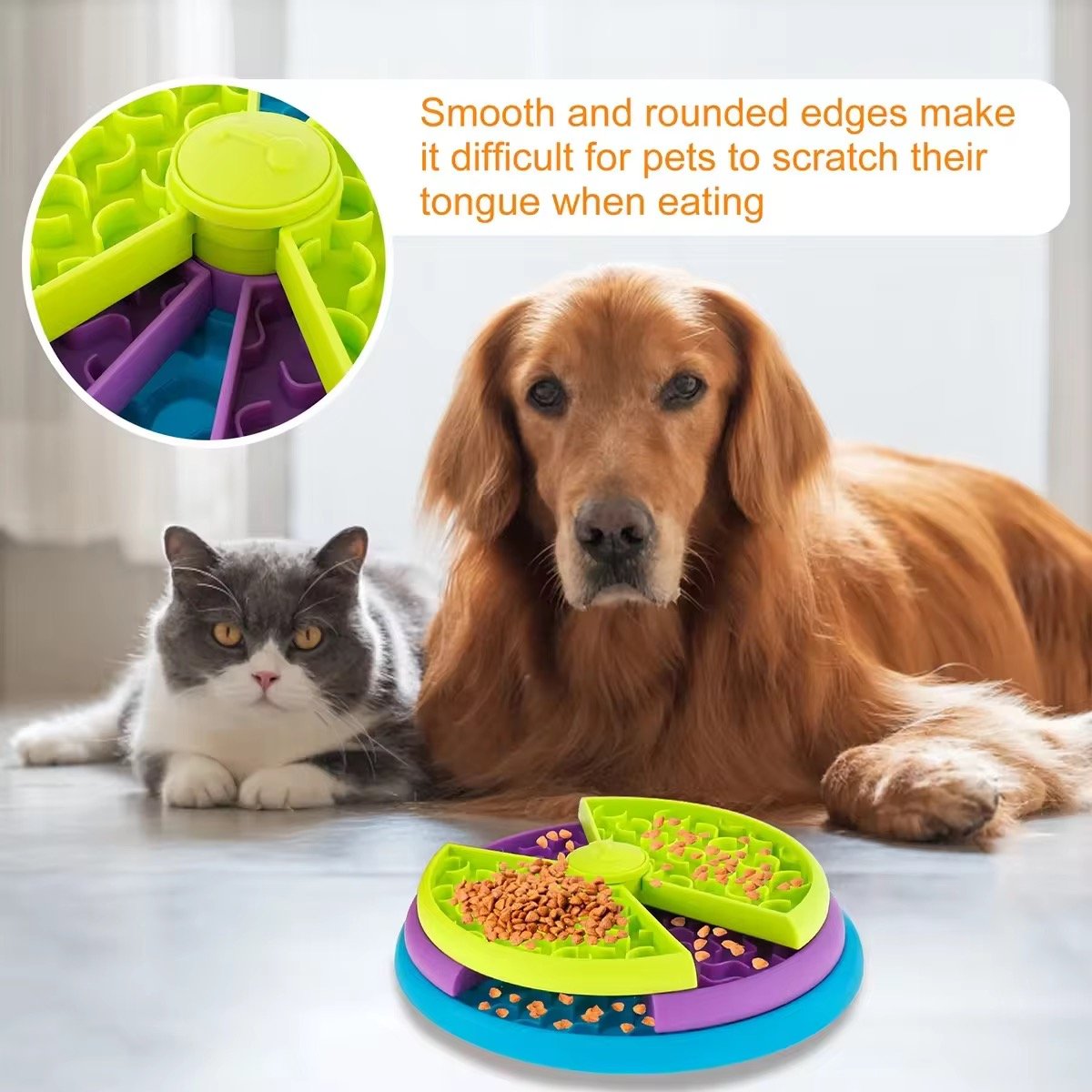
The Clearest Upgrade You Can Make
One bowl change. Immediate improvement at the very next meal. The Vozonix 3-Level Spinning Puzzle Feeder is BPA-free, dishwasher safe, and backed by a 2-year warranty.
Shop the Vozonix Slow Feeder — $24.99 →